EU AI Act
Compliance
The EU Artificial Intelligence Act introduces new obligations for organizations developing or using AI systems. Denforth helps teams assess risk, prepare required technical documentation, and stay aligned with evolving AI regulation.
What the EU AI Act Requires
The EU AI Act establishes a risk-based framework governing how AI systems are developed, deployed, and monitored.
- Risk classification of AI systems
- Technical documentation for high-risk AI (Annex IV)
- Risk management and human oversight
- Post-market monitoring and accountability
Innovative Solutions for Growth
Explore our comprehensive selection of services that cater to a variety of needs, ensuring complete customer satisfaction.
Risk Classification
Assess whether an AI system is prohibited, high-risk, or lower-risk under the EU AI Act.
Annex IV Documentation
Generate structured Annex IV technical documentation based on your system inputs.
Compliance Awareness
Stay informed as AI regulation evolves and understand how changes may affect your obligations.
Understanding the EU AI Act
The EU Artificial Intelligence Act establishes a risk-based regulatory framework for artificial intelligence systems placed on or used within the European Union. Organizations must understand how their AI systems are classified and what obligations apply at each risk level.
What the EU AI Act Requires
The EU AI Act introduces obligations that vary depending on the risk category of an AI system. Organizations are expected to assess their AI systems, document key technical and governance elements, and maintain accountability throughout the system’s lifecycle.
High-risk AI systems are subject to stricter requirements, including technical documentation, risk management, and post-deployment monitoring.
Risk-Based Classification
AI systems are classified as prohibited, high-risk, limited-risk, or minimal-risk, determining which obligations apply.
Annex IV Technical Documentation
High-risk AI systems must maintain structured technical documentation describing purpose, data, risks, and oversight mechanisms.
Human Oversight & Risk Management
Organizations must ensure appropriate human oversight and implement processes to identify and mitigate risks.
Post-Market Monitoring
Certain AI systems require ongoing monitoring to detect issues after deployment and respond to regulatory changes.
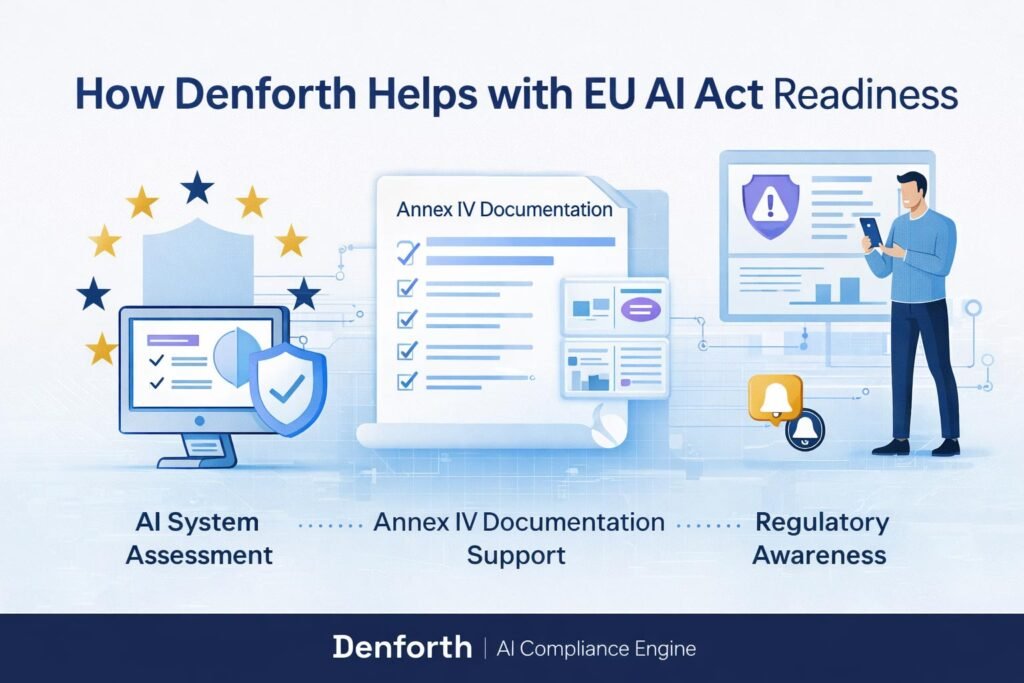
How Denforth Helps with EU AI Act Readiness
Denforth provides structured tools to help organizations prepare for EU AI Act obligations with clarity and confidence.
Structured Starting Point for Compliance
Denforth is designed to help teams understand where they stand under the EU AI Act and produce the documentation required for high-risk AI systems. The platform supports structured assessments, documentation generation, and compliance awareness, while keeping human review at the center.
AI System Assessment
Guided questionnaires help teams assess how their AI system is treated under the EU AI Act’s risk framework.
Annex IV Documentation Support
Structured drafts of Annex IV technical documentation are generated based on system inputs, ready for expert review.
Regulatory Awareness
Teams stay informed about regulatory developments and understand how changes may affect their AI systems.

Designed for a Changing Regulatory Landscape
While Denforth is currently focused on EU AI Act readiness, its compliance approach is designed to remain compatible with emerging frameworks such as the NIST AI Risk Management Framework, Canada’s AIDA, and ISO/IEC AI governance standards.
Important Note
Denforth provides informational and technical tools to support AI regulation readiness. It does not provide legal advice or regulatory determinations. All compliance decisions should be reviewed by qualified professionals.
Start Preparing for the EU AI Act
Get clarity on your AI system’s obligations and begin documenting with confidence.