High-risk AI is one of the most discussed concepts in the EU AI Act, and also one of the most misunderstood.
Many teams assume that high-risk means technically complex, autonomous, or experimental. Others assume it means unsafe or poorly designed. Neither interpretation is correct.
Under the EU AI Act, high-risk is not a technical judgment. It is a regulatory classification based on how and where an AI system is used.
The Act does not ask how advanced a model is. It asks what decisions the system influences and who is affected if it fails.
This distinction matters because it explains why relatively simple systems can be classified as high-risk, while more advanced systems may not be regulated at all.
What makes an AI system high-risk
An AI system is considered high-risk under the EU AI Act if it is used in contexts that can significantly affect people’s rights, access to services, or life opportunities.
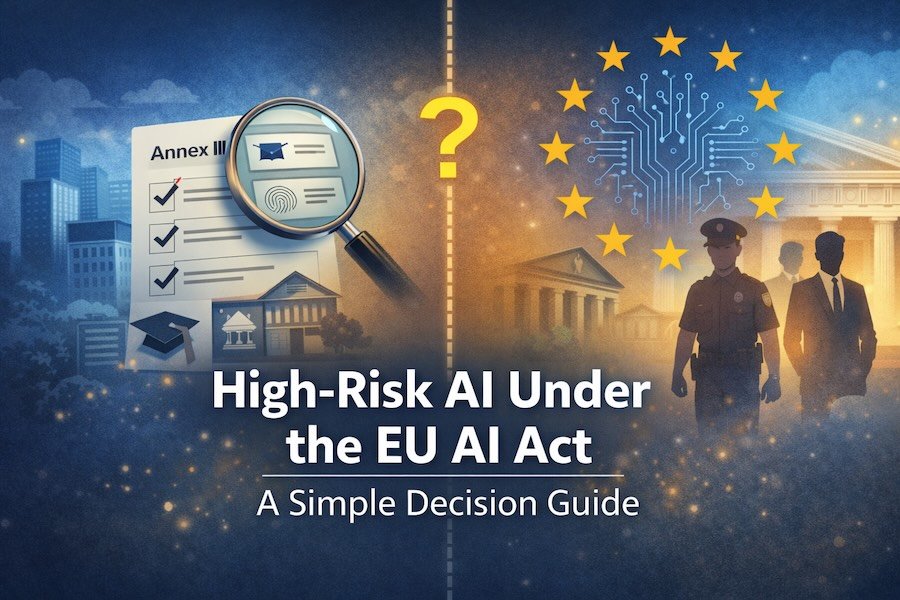
These contexts are listed in Annex III of the Regulation. They include areas such as employment, education, access to credit, biometric identification, and certain public sector uses.
What matters is not the algorithm, but the impact of the decision supported or made by the system.
A scoring model used for internal analytics may be low risk. The same scoring logic used to decide who gets a job interview or a loan may be high-risk.
Why context matters more than technology
Many teams focus on model architecture, training techniques, or accuracy metrics when thinking about risk. Those factors become relevant later, but they do not determine whether a system is high-risk.
The decisive factors are purpose and deployment context.
Ask two questions:
- What decision does this system influence?
- What happens to individuals if the system is wrong?
If the answers point to material consequences for individuals, the system may fall into the high-risk category, regardless of how simple the underlying technology is.
Who determines high-risk status
In most cases, the responsibility for classifying a system as high-risk lies with the provider.
This does not mean the decision is subjective. Providers are expected to assess intended purpose against the categories set out in the Act and document their reasoning.
Deployers also play a role. If a system is repurposed or used in a new context, risk classification may change. This is one reason why role clarity and documentation matter early.
A practical way to screen for high-risk AI
Instead of asking whether your system feels high-risk, a more stable approach is to screen it systematically.
A simple internal check often starts with:
- identifying the intended purpose of the system,
- mapping where and by whom it is used,
- comparing that use to the Annex III categories,
- and considering whether the system materially influences decisions about people.
This process does not require legal interpretation. It requires clarity and honesty about use.
Why early classification saves effort
High-risk classification triggers additional obligations later, including risk management processes, technical documentation, and conformity assessment.
Teams that identify this early can design with constraints in mind. Teams that delay often discover that compliance requires revisiting earlier design decisions.
The difference is not effort, but timing.
High-risk AI is not a label to fear. It is a signal to plan.
Understanding it early allows teams to build systems that are not only compliant, but also defensible and explainable over time.