Most AI compliance efforts don’t fail during audits.
They fail long before—quietly, structurally, and almost invisibly.
The failure begins at the moment a company confuses documentation with evidence.
The illusion of preparedness
In the early stages of AI governance, most teams move in a predictable way.
They assemble policies.
They define internal principles.
They produce frameworks that look coherent and well-structured.
On paper, everything appears aligned.
There is a governance model.
There are risk categories.
There are roles and responsibilities.
From a distance, it looks like compliance is taking shape.
But something critical is missing.
Not intent.
Not effort.
Not even structure.
What’s missing is proof.
What regulation actually evaluates
Regulation does not assess whether your organization has thought about risk.
It assesses whether you can demonstrate control over it.
This distinction is not philosophical. It is operational.
Under emerging frameworks, including the EU AI Act, compliance is not satisfied by stating that a system is “low risk” or “well governed.”
It requires that you can:
- reconstruct how that classification was made
- trace decisions across the system lifecycle
- demonstrate how outputs are monitored
- provide records that make the system auditable
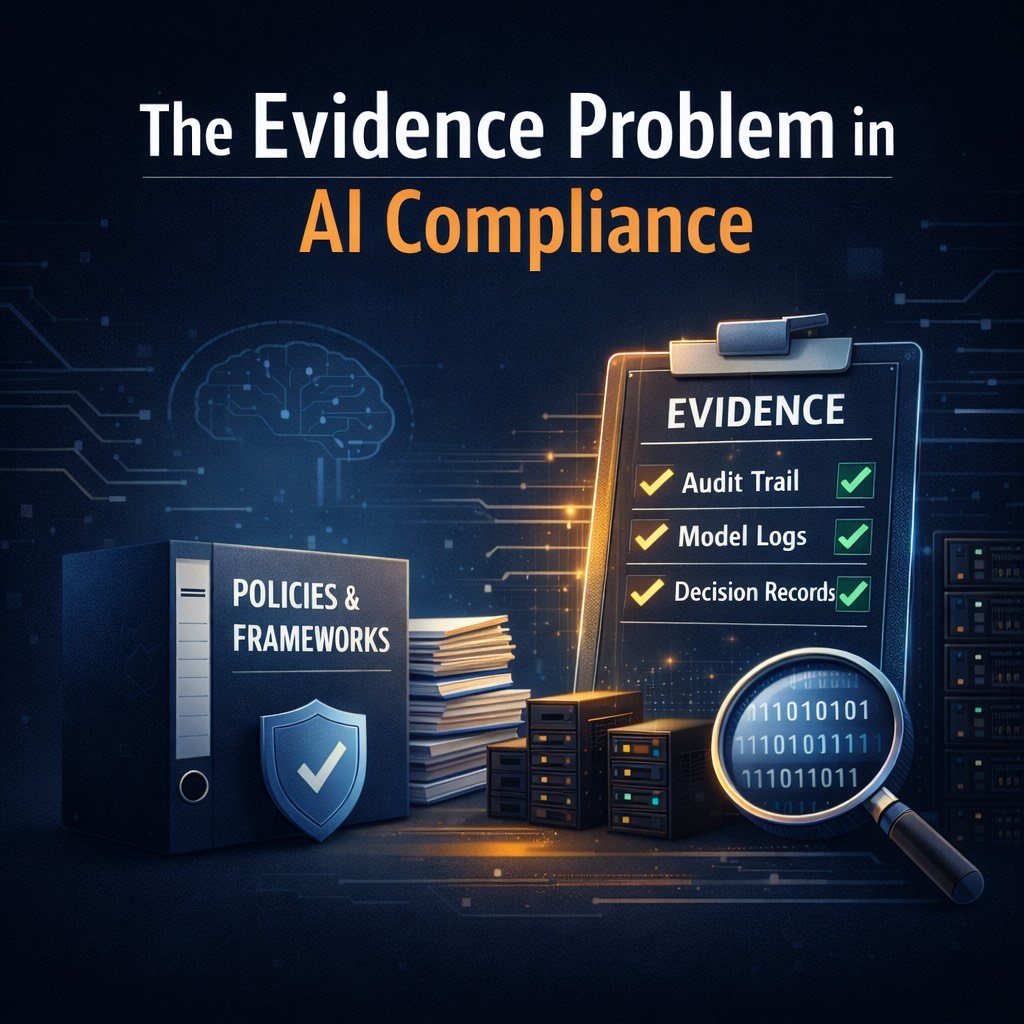
This is not documentation.
This is evidence architecture.
The structural gap: description vs. demonstration
Most organizations invest heavily in describing what they intend to do.
Very few invest in building systems that can show what actually happened.
This creates a subtle but decisive gap:
Documentation describes compliance.
Evidence proves it.
That gap is where compliance efforts break.
Where the breakdown happens
The failure is rarely dramatic.
It doesn’t look like a violation.
It looks like incompleteness.
A team is asked:
- How was this system classified?
- What data informed that decision?
- Can you show how outputs are evaluated over time?
And the answers exist—but only informally.
In conversations.
In scattered documents.
In individual judgment calls.
Not in a form that can be reproduced, traced, and audited.
At that point, the organization is not non-compliant in intention.
It is non-compliant in structure.
Evidence is not an afterthought
In many compliance programs, evidence is treated as something that comes later.
First define the framework.
Then implement controls.
Then document.
And eventually, if needed, gather proof.
This sequence is backwards.
Evidence is not the output of compliance.
It is the foundation of it.
If a decision cannot be captured, traced, and justified at the moment it is made,
it cannot be reconstructed later in a way that satisfies scrutiny.
The regulatory shift toward verifiability
This shift is not unique to AI.
Across European regulatory systems, there is a clear movement away from declarations and toward verifiable due diligence.
For example, the EU Deforestation Regulation requires operators to demonstrate—through traceable, geolocated data—that products are not linked to deforestation.
The emphasis is not on intent.
It is on provable origin and traceability.
AI regulation is following the same logic.
The system must not only be designed responsibly.
It must be demonstrably governed.
What real compliance looks like
Organizations that take this seriously start from a different premise.
They don’t ask:
“Do we have a policy?”
They ask:
- What decisions are we making?
- Where do those decisions occur?
- How are they recorded?
- Can they be reconstructed later?
From there, they build:
- decision logs instead of static descriptions
- traceability layers instead of isolated documents
- reproducible workflows instead of one-off judgments
Compliance becomes less about writing and more about system design.
The uncomfortable question
At some point, every organization working with AI will face a simple test:
If someone asked today, what could we actually show?
Not what could be explained.
Not what could be drafted quickly.
Not what exists in principle.
What could be produced, examined, and verified.
If the answer is unclear, the issue is not a missing policy.
It is an evidence gap.
Closing
AI compliance does not fail because organizations ignore regulation.
It fails because they prepare in the wrong dimension.
They build narratives.
Regulation evaluates systems.
And systems are judged by what they can prove.