
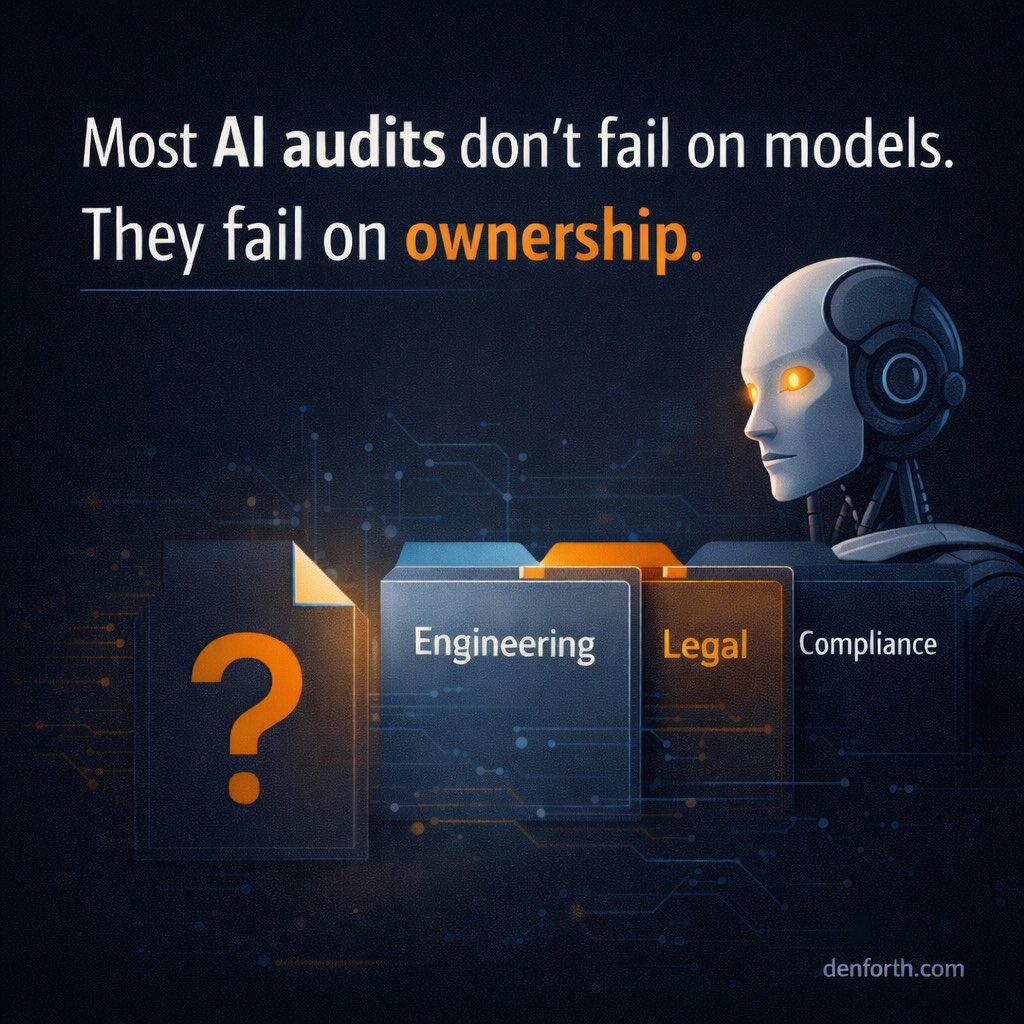
There’s a moment in almost every AI governance discussion when the conversation quietly shifts.
At first, it sounds technical:
What models are we using? How are they trained? What safeguards are in place?
But very quickly, a more uncomfortable question emerges:
“Who actually owns this?”
And that’s where things start to unravel.
The invisible gap
Most teams assume AI risk is a technical problem.
So they assign it—implicitly or explicitly—to engineering.
Engineering, in turn, assumes:
- Legal will define constraints
- Compliance will interpret regulations
- Product will decide use cases
And so ownership dissolves across the organization.
Not because anyone is avoiding responsibility—but because everyone is operating within their own domain logic.
The result is subtle but critical:
AI systems exist. Governance does not.
Why audits expose this immediately
The first real audit—whether internal, procurement-driven, or regulatory—doesn’t begin by inspecting your model.
It begins by asking for structure:
- Who approved this system?
- What risk classification was applied?
- What documentation exists?
- How are decisions tracked over time?
These are not technical questions.
They are organizational questions disguised as compliance questions.
And when there is no clear answer, it doesn’t matter how sophisticated the model is.
The audit stalls.
Ownership is not a role — it’s a system
Many companies respond by trying to “assign” ownership.
They create a committee.
They name a responsible person.
They schedule recurring meetings.
This helps—but only partially.
Because AI governance doesn’t behave like traditional compliance domains.
It cuts across:
- product decisions
- engineering implementation
- legal interpretation
- operational monitoring
So ownership cannot live in one function.
It has to be structured across them.
What actually works
The organizations that move forward fastest do something different.
They don’t start with policies.
They start by defining how ownership flows through the lifecycle of an AI system.
Not in theory—but in practice:
- Who classifies risk, and when
- Who validates that classification
- Who is accountable for documentation
- Who maintains evidence over time
This creates something much more valuable than a policy:
a working governance system
The quiet advantage
Here’s what’s often underestimated.
When ownership is clear:
- audits become procedural, not disruptive
- procurement conversations accelerate
- internal decision-making speeds up
Because the organization no longer pauses to ask:
“Who is responsible for this?”
It already knows.
Closing thought
AI governance is often framed as a documentation challenge.
In reality, it’s a coordination problem.
And coordination starts with ownership.
Not assigned ownership.
Designed ownership.