
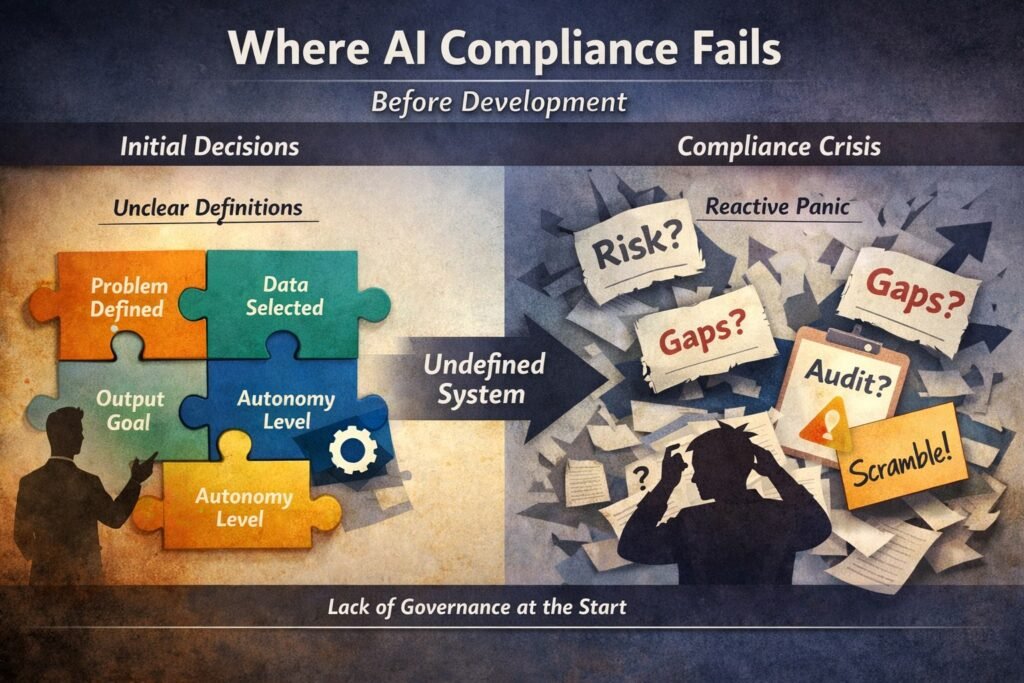
Most teams think AI compliance starts when the system is built.
It doesn’t.
By the time you are thinking about documentation, testing, or risk classification, most of the important decisions have already been made — implicitly, and often without governance.
This is where compliance actually begins.
The EU AI Act defines an AI system not as a finished product, but as something that evolves across design, deployment, and use.
It explicitly recognizes that AI systems:
- derive outputs such as predictions, content, or decisions
- operate with varying levels of autonomy
- influence both digital and physical environments
This means compliance is not tied to a moment.
It is tied to a structure.
The real starting point is not the model — it is the decision
Before any model is trained, teams already decide:
- what problem is being solved
- what type of output is acceptable
- what data will be used or excluded
- what level of autonomy is tolerated
These decisions define the system’s risk surface long before any technical implementation.
And yet, they are rarely documented.
This is where most compliance failures originate
When governance is missing at the decision stage:
- risk classification becomes reactive
- documentation becomes reconstruction
- accountability becomes unclear
Instead of explaining a system, teams end up justifying it.
The regulatory logic is consistent
The AI Act follows a risk-based approach, where obligations scale with the potential impact of the system
But this approach assumes something critical:
👉 that the system boundaries and intended purpose are already clearly defined
Without that, risk classification becomes guesswork.
The hidden dependency: system definition
Before you can classify risk, you need to answer:
- What exactly is the AI system?
- What decisions does it influence?
- Who is affected by its outputs?
If these answers are unstable, everything downstream becomes unstable:
- classification
- documentation
- monitoring
- audit readiness
Why this matters for real companies
In practice, this shows up as:
- multiple teams describing the same system differently
- unclear ownership between product, data, and legal
- last-minute compliance efforts before procurement or audit
At that point, the cost is not just compliance effort.
It is loss of control over the system narrative.
The shift: from compliance tasks to governance structure
Teams that handle this well do something different.
They do not start with:
“What documents do we need?”
They start with:
“What exactly are we building, and how does it behave?”
From there, everything else becomes structured:
- risk classification becomes deterministic
- documentation becomes descriptive, not defensive
- governance becomes embedded, not external
Final thought
AI compliance does not begin with regulation.
It begins with definition.
And if that definition is unclear, every compliance step that follows will carry that uncertainty forward.

